The Kestrel Iota Business Command Center

The one console that orchestrates every Iota and agent, so your business acts on problems before they cost you.

Kestrel Command is one platform that runs your businesses at a level you can't reach alone. It orchestrates the Iotas to watch every part of the business against its plan, catch what's drifting before it costs a month to fix, and draft the response so a named person only has to say go. Point it at whatever level you run: a company, a division, a business unit, a region or a single site. One picture across all of them, built from whatever each one already runs.

Alone, they're tools.

Buy them separately.

Or buy them as a whole.

Kestrel Command. Every company, business unit and site on one screen, every decision waiting in one queue, and the answer already drafted.

We build across the leading AI solutions.

We use the best tool for each job from across the whole AI ecosystem: frontier models, models that run on your own hardware, and the frameworks that connect them. When something better ships, we move to it, so you are never locked in to one vendor.

Product names and logos are trademarks of their owners, shown only to say which models and tools we build with. Kestrel Iota is independent and is not a partner of, or endorsed by, any of these companies.

Try the console

This is the screen your Monday starts on.

Seven things need a decision this week. Each one arrives with the evidence, a named owner and the response already drafted. Pick one and approve it.

AI Business Command Center

Kestrel Command, 6 companies, 27 sources, synced 4 min ago

LiveDraft onlyWeek 11, quarter plan
Needs a decision73 critical
Cash at risk$612kageing past terms
Milestones late4of 31 this quarter
Pipeline vs plan-18%Company 12 driving it
Targets sourced113 clear the thesis
Awaiting approval7none sent yet

This week, 7 escalations

A demonstration. Approving here sends nothing, and the companies and figures are illustrative, not client data.

Explore the Iotas

What each Iota actually does.

What is an Iota?

An agent is given a goal. An Iota is given a job.

The distinction that matters is control flow versus generation. An agent's control flow is model-directed: at each step it decides what to do next, and that decision is drawn from a probability distribution, not looked up in a table. An Iota's control flow is code-defined: the steps, their order, and the stopping condition are fixed before the model runs, the way a finite element model breaks a continuous problem into small, bounded elements before solving any of them. Only the content inside each step is generated.

That difference compounds. In an agent chain, each step's probabilistic output becomes the next step's input, so a small per-step error rate multiplies across the chain instead of staying constant. Try it below.

The term Iota, for this class of single-task, code-bounded AI deployment, was first formally defined by Kestrel Iota in 2026.

Independent steps, no recovery. Reads the sliders below.

10 steps at 98% each succeed end to end 82% of the time, assuming nothing checks or recovers along the way.

An Iota stays narrow so there are fewer uncertain decisions to chain, and each one can be validated before the next step runs.

Move the sliders. Both fields below read them live.

Agent: unboundedIota: bounded
Same job, two ways to build it. Pick a metric above to focus it.
AgentIota
PrecisionModel picks its own route each runRoute fixed in code; the model only fills bounded slots
CostReplanning adds calls, context, reasoning tokensNarrow task, smaller model, bounded inference budget
Slop riskUnchecked intermediate state redirects later stepsValidation gates reject bad state before it propagates
What it didTrajectory differs run to run, so traces must be evaluatedSame stages every run, so assertions can be written against them
Who can run itUsually whoever built itYour own team, day to day
Completion timePath-dependent: planning, tool calls and retries all add to itEasier to budget, since the stages are fixed in advance
Cost of a changeA new goal needs little new code, but changed behavior needs re-evaluationEdits are localized to one stage; work outside the scope needs new code
Diagnosing a failureMeans reading the tool calls, intermediate state and model decisionsMeans reading one stage's input and output against its contract
Context footprintInstructions, tool definitions and results all compete for contextEach stage gets only the input that stage needs

Same job, put under pressure. Pick what changes mid-run.

An unfamiliar task arrives mid-run, with no warning.

Agent

Replans using its existing tools immediately. No code change, but the new plan runs unverified the first time.

Iota

Stops at the edge of what it's scoped for and hands off to a person. Extending it is a small, planned code change, not something that happens unattended in production.

By month end, it has already happened.

Every business runs to a plan: targets, milestones, a budget, dates people agreed to. And every business drifts away from it, quietly, in one department or one company, for weeks.

You find out at month end. Thirty days after the drift started, in a pack that tells you what already happened, with no owner attached and nothing you can do from the page.

More reporting will not fix this, and neither will another dashboard, because a dashboard waits for someone to remember to open it. The information exists. What is missing is something that acts on it while acting is still cheap.

  • Drift is invisible while it is small

    The month it starts is the month you could have fixed it for nothing. By the quarter, it is a number on a board slide.

  • Every part of the business reports differently

    Each acquisition, division and region arrives with its own systems and conventions. Standardising them is a project that never finishes.

  • Alerts without owners change nothing

    A notification nobody is accountable for is noise. Within a fortnight, people stop reading them.

  • Seeing it is only half the job

    Someone still has to write the email, build the report and chase the answer.

The alert and the answer, in the same place.

This is what an escalation looks like: the problem, the evidence, the cause and every step of the fix, already prepared in the tools you run, instead of a chart that hints at one.

Kestrel Command, 27 sources, 6 companiesEscalation 3 of 7

Critical, cash

Receivables at 100 daysCompany 32

Receivables at Company 32 have been outstanding 100 days against a 45-day plan. That is $340,000 of cash sitting still.

It did not appear in last month's pack. The drift began in week three and has widened every week since.

The cause sits outside the ledger. The customer's accounts payable team rejected both invoices in week three, because neither carried a purchase order number, and nobody on our side was told.

Owner: Regional Sales DirectorLedger, ERP, CRM, inboxFirst flagged 6 weeks ago

The fix, four steps, awaiting your approval

  1. ERP

    Purchase order ready to post. A record for the customer's PO 4471, taken from their original order email, drafted against the open sales order and matched to both invoices.

  2. Accounting

    Invoices ready to reissue. INV-2291 and INV-2304 regenerated with the PO number, queued to go back to the customer's accounts payable.

  3. Email

    A note for the customer. Drafted for their accounts payable lead, to send with the invoices.

    To Accounts Payable, Northfield Supply

    We have reissued both invoices with your PO 4471. Could you confirm they are in your next payment run?

  4. Escalation

    A brief for the account owner. The Regional Sales Director gets the aged debt report, the fix above, and a 15-minute call held in both diaries for Thursday.

Nothing runs until you approve. Then each step runs in the system it belongs to, and the log records who approved it.

An illustrative example. The companies and figures are not client data. Nothing leaves without a person approving it, and there is no setting that turns that off.

See

Every company, division, business unit and site on one screen, continuously, whatever each one runs underneath: cash, receivables, pipeline, margin, milestones, compliance.

Escalate

It raises what needs a decision without being asked, with a named owner and the evidence behind it. You do not have to remember to look.

Act

The response arrives already prepared in the tools you run: purchase order, invoice, email, meeting, report or approval. Your job is judgement and a click.

Every escalation ends in something you can send.

When this happensKestrel Command does this
Receivables age past planFinds the cause, fixes the paperwork, tells the customer, briefs the account owner
Month end approachesBuilds the board report from live figures across every company and business unit
An acquisition target fits the thesisSurfaces it, maps the group behind it, drafts the approach
A diligence folder is incompleteNames the missing evidence and requests it from the owner
A 100-day milestone slipsEscalates to the accountable owner with a recovery plan
Leadership needs to meet on itSchedules the meeting, with the agenda already written
An answer is needed from a companyDrafts the question, routes it, tracks the reply
Pipeline drops below planFinds and scores new prospects, drafts the approaches

Why can't the platform you already pay for do this?

Because the big platforms need every company underneath to run on them first. Yours never will.

They ask you to standardise first. Kestrel Command works because your companies are different.

One system, made of pieces that also stand alone.

You do not have to buy all of it. Start where the pain is, and connect the rest when you are ready.

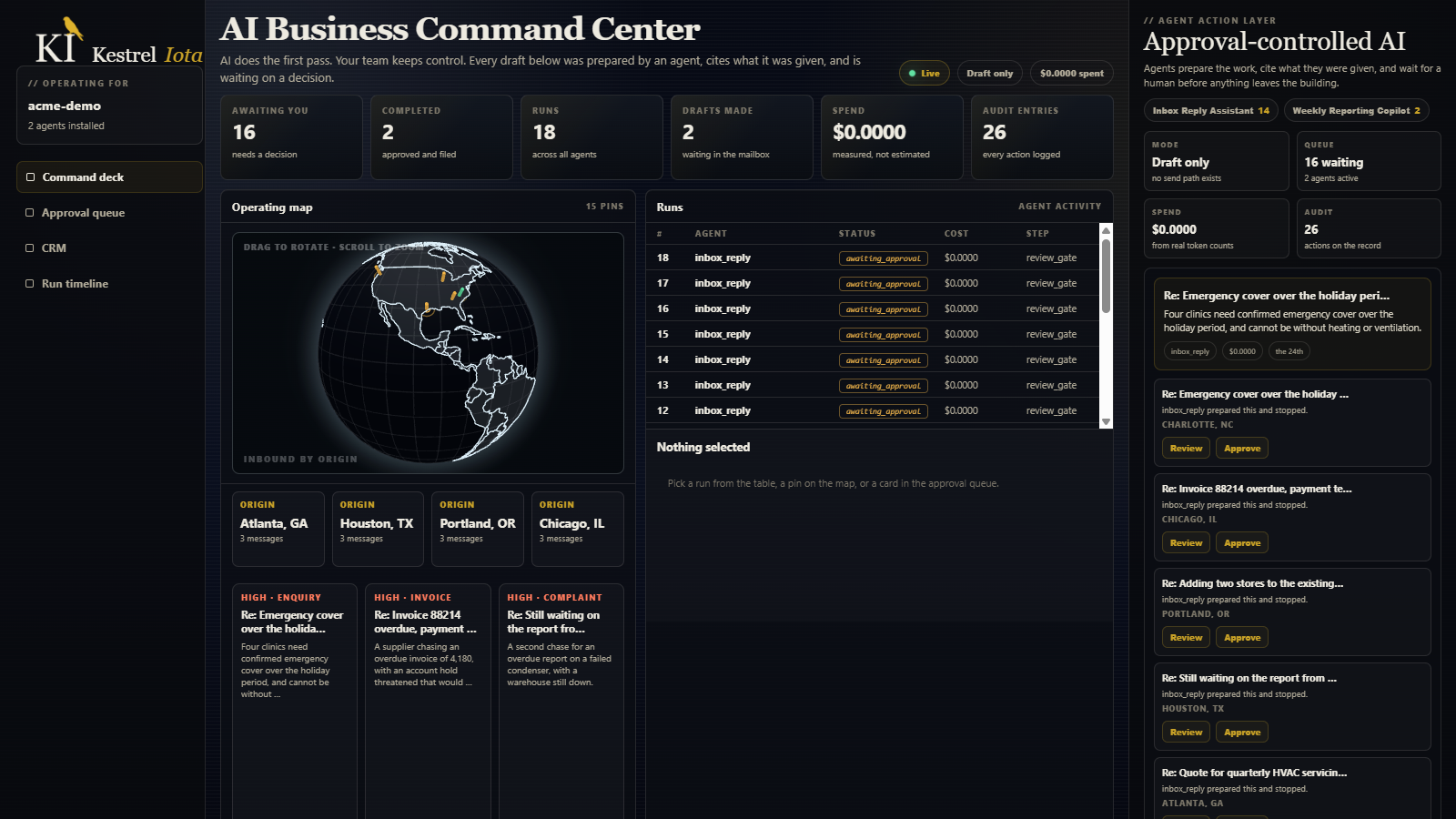
The Kestrel Iota Business Command Center console, with an approval queue, run log and operating map

Kestrel Command

The console. It sees every company, business unit and site, escalates what needs a decision and drafts the response. The other layers serve it.

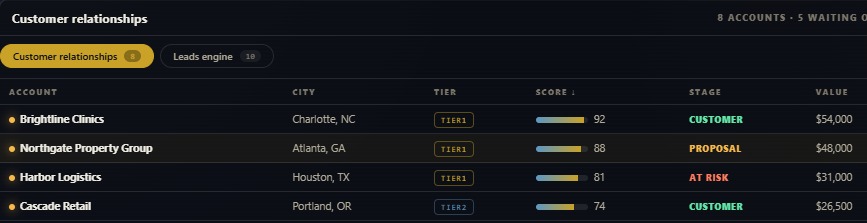
The relationships view in the Kestrel Iota CRM: accounts with city, tier, score, stage and value, including customers, a prospect at proposal, an account at risk and a supplier

Relationships

Customer, supplier and partner management, in one book.

Every relationship the business depends on, in one place: scored, staged and watched. It finds the customers each business needs and the companies a group should buy, keeps suppliers and partners alongside them, and drafts the next approach for a person to approve.

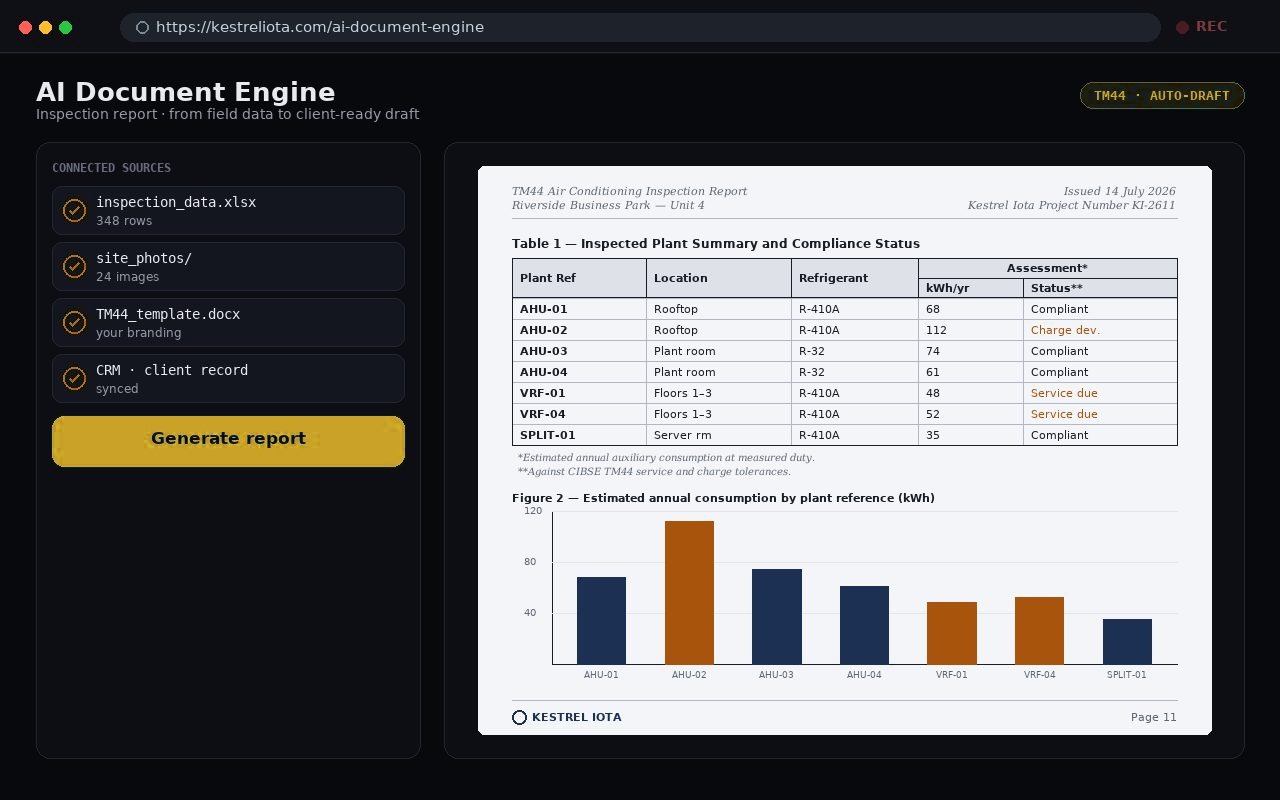
The Document Engine Iota drafting an inspection report from connected sources: a spreadsheet, site photos, a template and the CRM record

The Iotas

The single-job tools that power Kestrel Command. Each one also runs on its own, so you can start with whichever job hurts most and connect the rest later. See all of them.

An iota is the smallest thing there is. Ours are small enough to deploy on their own and built to fit together.

It drafts. You decide. Always.

Every serious buyer asks what happens when it is wrong. The answer: nothing it produces reaches anyone until a person says so.

Human approval on every action

Nothing is sent, published or committed without a named person approving it. There is no autonomous mode to switch on.

Full audit trail

Every escalation, draft, edit, approval and send is logged with who, what and when.

Source lineage on every figure

Each number traces back to the system it came from, when it was read and the rule that produced it.

Draft-only by default

The system's resting state is proposing. Acting takes a person, every time.

Role-based access

A company, business unit or site sees its own numbers. Group sees all of it. Nobody sees more than their role allows.

Your data stays in your tenant

Your operating data is not pooled, not shared between clients and not used to train anything.

The questions people ask about AI in their business.

Getting started

What is an AI business command center?

An AI business command center is one console that watches a business, or a whole portfolio of them, raises what needs a decision, and drafts the response ready to send. A reporting tool stops once it has shown you the number. Kestrel Command, the command center Kestrel Iota builds, carries on into the email, report or approval that answers it, then waits for a named person to say go.

Which AI tools are right for a small or medium business?

Start with the job that hurts most, not with a platform. In most small and medium businesses that is one of four: drafting documents and reports, answering an inbox, chasing work that has gone quiet, or watching a queue nobody has time to watch. Kestrel Iota builds a tool for each of those, and each can be bought on its own, so your first purchase is one job rather than a rollout. If you are not sure which job comes first, book a meeting and we will help you pick.

How do you keep an AI agent from acting without approval?

Kestrel Iota agents draft and then stop. Every action an Iota prepares needs a named approver, and nothing is sent, published or committed until that person says yes. Runs, drafts and spend are measured rather than estimated, and every action is logged, so you can always see what an agent did last week.

Kestrel Command

How is this different from the BI dashboard we already have?

A dashboard waits for you to open it and then shows you a number. Kestrel Command comes to you, names the person who owns the problem, and has the response already drafted. Most BI tools explain why a figure moved. Kestrel Iota built Kestrel Command for what happens next, while there is still time to act.

Why can't the AI built into our CRM or office suite do this?

The AI inside a CRM or office suite only works on that vendor's platform. A group whose companies run three different stacks, plus an accounting package inherited with an acquisition, cannot use any one of them across the group. Kestrel Command reads whatever each company already runs, so nobody has to move.

What happens when it gets something wrong?

A named person reviews every Kestrel Command draft before it goes out, so a mistake can be caught and corrected before anyone else sees it. Every figure links back to the system it came from, so when a number looks wrong you can check the source in one click.

Does it take actions on its own?

Kestrel Command never acts on its own: it drafts, and a named person approves before anything goes out. Every email, report, approval and meeting invitation waits in a queue until someone sends it, and Kestrel Iota does not offer a setting that removes that step.

Is there an audit trail of what the AI did?

Every escalation, draft, edit, approval and send in Kestrel Command is logged with who did it and when. If anyone asks why something went out or who signed it off, the answer is a lookup. The same log covers any Iota running on its own.

Your data

Where does our data go, and do you train AI models on it?

Your data stays in your environment, and Kestrel Iota does not use it to train any model. It is never pooled with or shared between clients, and you can see which system every figure came from. If your IT or security team has detailed questions, book a meeting and we will take them through the setup.

How do you stop one company or business unit seeing another's numbers?

Each company, business unit or site sees only its own numbers, because access in Kestrel Command is set by role and by level. Each one sees its own business, group leadership sees across all of them, and nobody sees more than their role allows. Kestrel Iota sets this up with you at the start rather than leaving it to a default.

Groups and multiple companies

Can one system report across companies that all use different software?

Kestrel Command brings companies on different software into one view, which is the problem Kestrel Iota built it to solve. It reads what each company already runs, whether that is an accounting package, a CRM or the folder the monthly reports sit in, and holds one picture across all of them. Groups that grow by acquisition rarely finish standardising, so a tool that needs everyone on one platform is hard to justify.

Is this AI software for private equity portfolio companies?

Kestrel Command suits portfolio companies, and it is built for the operating side rather than the fund side. Fund reporting tools report up to investors. Kestrel Command works down into the companies, tracking value creation plans, 100-day plans and integration milestones against what is actually happening, and puts the fix in front of the person who can approve it.

Does it work for a single business, or only for a group?

A single business can use Kestrel Command, which works the same way for one company as for a group of eighty. For a smaller business, one Iota on its own is often the better buy, and the AI Opportunity Assessment tells you which. Book a meeting and Kestrel Iota will tell you honestly which fits.

Buying

How do we start working with Kestrel Iota?

Working with Kestrel Iota runs in three paid steps. First, a fixed-fee AI Opportunity Assessment finds the work in your business worth handing to AI, and says plainly if there is none yet. Second, a proof of value runs one of those jobs on your own data and measures it against a number agreed at the start. Third, if it hits that number, you decide whether to continue on a subscription. Every step starts with a conversation, so book a meeting to begin.

How is Kestrel Command priced?

Kestrel Command is a subscription: a platform fee plus a charge for each operating company connected to it. The assessment and the proof of value are paid separately, before the subscription starts. Kestrel Iota does not charge per user, because a handful of leaders use the console while the work happens across every company. The figure depends on how many companies and systems are involved, so book a meeting and we will price it against your setup.

Is there a free trial?

Kestrel Iota does not offer a free trial, because Kestrel Command has to be connected to your own systems before it can show you anything about your business. The demonstration on this page shows how it works. For your own data, the proof of value is the trial: a short, paid engagement, with the measure of success agreed before it starts, and you decide at the end whether to carry on.

How long does implementation take?

A typical Kestrel Iota engagement runs a two-week AI Opportunity Assessment, then a four-week proof of value on one agreed workflow. For Kestrel Command, the proof of value ends with a live console flagging three to five kinds of issue and a working approval queue across the companies you chose. Rolling out further can start from week seven if you decide to go ahead. A single Iota on its own usually takes weeks, not months. For a timeline against your own systems, book a meeting.

Can we buy one Iota instead of the whole platform?

Kestrel Iota sells every Iota on its own. You can start with the one that hurts most and add others later, or never. An Iota deployed on its own joins Kestrel Command later without being rebuilt.

Find out what is drifting this month.

A 30-minute conversation about how your companies and business units report today, and what you would want to know sooner. No deck.