 Kestrel Iota
AI strategy and implementation services
AI strategy, agent design and implementation.
Kestrel Iota plans, designs and builds AI for small, medium and large businesses, with your team rather than for it. We find where AI pays in your operation, design agents sized to the job so they stay cheap to run, put engineers inside your team to build them, and leave your people able to run them without us.
If the return does not hold up, the assessment says so and we stop. Recommending against a build is a normal outcome here, not a failed one.
Strategic AI services
We turn AI into business value.
We work with your leadership team to find the AI opportunities worth the most, build focused pilots against a number, and scale the ones that hold up. If you would rather start with a product, every Iota can be bought and deployed on its own, and we handle the setup.
- AI Opportunity Assessment and roadmap. Your operations, workflows and data mapped, every opportunity ranked by return and difficulty, and a roadmap sequenced by impact and feasibility.
- Agent design and pilot implementation. One workflow designed and built in weeks, with the measure of success agreed before the build starts.
- Workflow automation. The repetitive work taken out of reports, inboxes, follow-ups and queues, with a person approving anything that leaves.
- Scale and integration across the business. Pilots that proved themselves become permanent, wired into your systems and handed over with training.
- Cost-effective AI. The right model for each job rather than the biggest one, token spend measured per agent, and calls merged where the work allows it.
A typical engagement. Timings are indicative and set with you at the start.
- Weeks 1 to 2
Assess and plan
Operations mapped, opportunities ranked by return, and a roadmap you can take to the board.
- Weeks 3 to 6
Pilot
One workflow built and measured against the number agreed at the start, with change management from day one.
- Week 7 onwards
Scale
Into production, integrated with your systems, and handed over with training so your team runs it.
How we work
From complexity to operational clarity.
Four stages, and each one has to earn the next. You see the return before anyone asks you to fund a build, and your own team runs what we hand over.
-
Diagnostic assessment
We map your operations, workflows and data to find where AI creates value you can measure, then price each opportunity in hard numbers. If nothing is worth doing yet, the assessment says so.
You leave with every opportunity ranked by return and difficulty, and the number each one is worth.
-
Strategic roadmap
A prioritised plan tied to your business model, financial goals and constraints, sequenced by impact and feasibility rather than by whichever tool is in the news this month.
You leave with a roadmap your board can approve, where every item has an owner and a number to hit.
-
Focused implementation
Targeted pilots built in weeks, not quarters, by engineers working inside your team on your own systems, with change management and measurement from the first day.
You leave with one workflow running in production and a measured result against the number you agreed.
-
Scale and make it permanent
Pilots that prove themselves become part of how the business runs. We hand the capability to your people, so the returns keep coming after we have gone.
You leave with AI your team owns, operates and can extend without calling us.
AI training and enablement
Your people are already paying for AI.
Is anyone checking what it buys? Staff sign up for tools on company cards, build agents that loop and retry all night, and reach for the largest model to do the smallest job. Across a business that can run to thousands of dollars a month, with nothing to show for it at the end. We train your people to build AI that pays for itself.
- Enable the people who will use it. Role-based training on your own processes: how to get a useful answer, how to check it, and when not to trust it.
- Build the first agents with them. We co-build agents with the staff who will run them, using the single-job patterns we have tested in our own products, so what they learn is how to build the next one.
- Stop the runaway bill. Right-sized models, a spend limit on every agent, and monitoring that catches a looping agent the day it starts rather than on the month-end invoice.
Estimate your AI spend
$120,000 a year
$10,000 a month
Do you know what it is buying?
Your figures, multiplied: subscriptions plus usage, per person. The assessment measures the real number for your business.
Talk to us about trainingWe work through your AI centre of excellence.
The businesses getting value from AI have a small team that builds the agents everyone else uses. We join yours, or help you set one up, and build alongside the business stakeholders who know where the work actually is. That holds inside one operating company or business unit, across a group, and in the governance that sits under both.
Business teams
Know where the work is and what good looks like.
Your AI centre of excellence
Builds and runs the shared agents everyone uses.
Kestrel Iota engineers
Build alongside, train, and step back once your team is ready.
Shared standards for governance, security and cost control
What the services are built on
The Iotas, and one console.
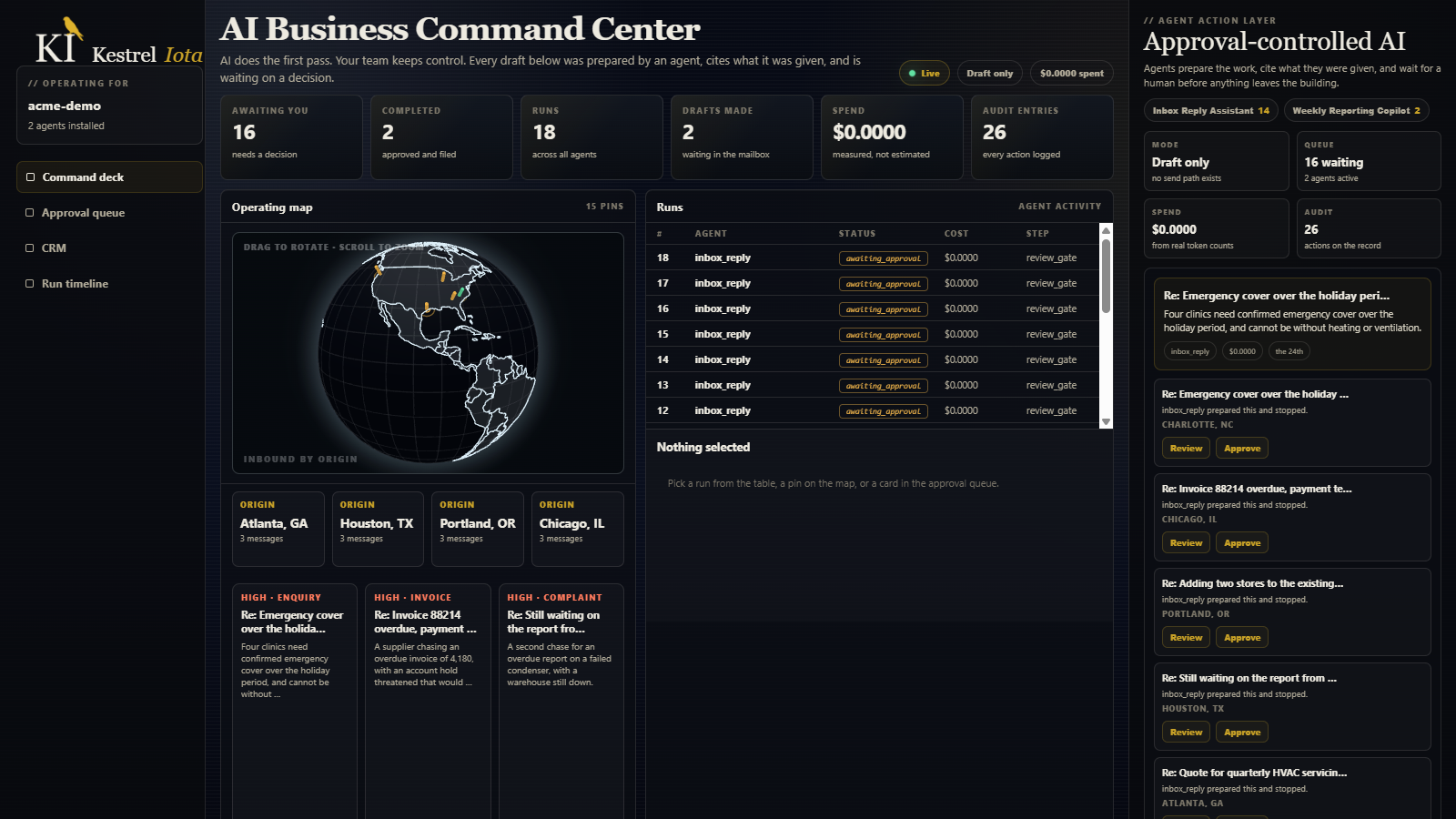
Each Iota is a separate machine with one job: drafting a document, answering an inbox, chasing a report, watching a queue. Each runs inside the Business Command Center, and each can also be bought and implemented on its own, depending on the use case.
When an Iota finds something worth doing, it drafts the action and waits for a named person to approve it. Draft only, until someone says go.
Where this usually starts
Start with the assessment.
We go through a business in detail, find where AI actually pays, and rank the opportunities by return so the choice is obvious. The output is a report built to go in front of a board, not a slide deck someone still has to translate.
One business, reviewed in detail, with a written recommendation at the end.
Or start smaller, with the 30-minute strategy session below.
Questions
What businesses ask us about AI.
Choosing a partner
Who can help a small or medium business implement AI?
Kestrel Iota plans, designs and builds AI for small and medium businesses, as well as for larger companies and groups. We start with an AI Opportunity Assessment that ranks the work in your business by return and difficulty, build the first tool with your team on your own systems, and hand it over so your people run it.
How do you choose an AI implementation partner?
Ask three questions. Will they price the return before writing code, and tell you to stop if the number does not hold up? Will their engineers build inside your team, on your systems? And can your own people run the result without them? Kestrel Iota is built around a yes to all three, which is why our assessment is allowed to recommend building nothing yet.
Does Kestrel Iota work with large businesses and groups of companies?
Yes. For a group, Kestrel Iota looks for work that repeats across operating companies, so one solution can be built once and rolled out, which is cheaper to run on both tokens and time. The Business Command Center then watches the whole portfolio against plan, with access set per company.
Strategy and design
What should an AI strategy for a business include?
A useful AI strategy names the workflows worth automating, the return each one should produce, the order to build them in, and who owns each one afterwards. Kestrel Iota delivers it as a roadmap sequenced by impact and feasibility, tied to your plan and budget rather than to a list of tools.
What is an AI Opportunity Assessment?
The AI Opportunity Assessment is a written review of how work moves through one business, which of it AI can do faster or better, and what each opportunity is worth. Every opportunity gets one of three verdicts from Kestrel Iota: something that already exists fits, something should be built, or it is not worth doing yet.
What are tailored AI solutions, and when are they worth more than off-the-shelf AI?
A tailored AI solution is scoped to one piece of work in your business: your document formats, your approval chain, your systems of record. It is worth more than an off-the-shelf tool when the job depends on knowledge only your company holds, and worth less when a product already does the job. Kestrel Iota compares the two at the mapping stage instead of assuming custom.
Agents
How does Kestrel Iota design AI agents?
Kestrel Iota designs each agent around one bounded job, which we call an Iota: its steps, inputs and stopping point are fixed in code, and the model only fills defined slots. Every agent has a named owner, a list of what it may read and do, and an approval step before anything leaves the business.
What does AI agent implementation involve?
Implementation means building the agent on your systems, testing it against real cases, and setting up monitoring for accuracy, permissions and cost. Kestrel Iota treats an agent as unfinished until someone inside your company owns it and runs it day to day.
How do you keep an AI agent from acting without approval?
Draft first, until a person says go. Every action a Kestrel Iota agent prepares waits for a named approver, and nothing is sent, published or committed before that. Every run, draft and approval is logged.
Cost and running
How can a business make AI cost-effective?
Match the model to the job instead of using the largest one everywhere, keep each task narrow so it needs less reasoning, and measure spend per agent. Kestrel Iota builds single-job Iotas for this reason, and its Token Optimizer merges small calls into larger ones and moves routine work to cheaper models.
How do you keep AI running costs under control after launch?
Kestrel Iota measures runs, drafts and spend per agent from real token counts rather than estimates. Once a tool is live we keep checking whether it is still worth what it costs, a question most deployments stop asking after launch.
Who owns the AI tools Kestrel Iota builds?
You do. The work is built on your systems and your team's knowledge, and your people run it afterwards. A tool nobody inside the company can operate counts as a failed build for us.
Working together
What is forward deployed engineering?
Forward deployed engineering means the engineers who build the tool sit inside your team while they build it, instead of working from a ticket queue. For AI work that matters, because the hard part is context: which document is authoritative, who signs off, what the exceptions are.
What is an AI centre of excellence, and do we need one?
An AI centre of excellence is a small team, usually in IT, that builds and runs the shared agents so each department does not solve the same problem its own way. You need one once staff are using AI on personal subscriptions, which in most companies has already started. Kestrel Iota joins that team and trains it rather than replacing it.
How long does an AI project with Kestrel Iota take?
A typical engagement runs two weeks of assessment, four weeks of pilot on one workflow, and then scale from week seven. A single Iota deployed on its own usually takes weeks rather than months.
Contact
Book a 30-minute strategy session.
Tell us where the work piles up. In half an hour we will name the AI opportunity most worth your time and outline a path to a measurable result, whether or not you go on to work with us.
- Thirty minutes, on your business. A focused conversation about your operation, not a product tour.
- No obligation. If nothing is worth doing yet, that is what we will tell you.
- Something you can act on. At least one concrete opportunity, with or without us.
Prefer email? Write to sales@kestreliota.com.
Thank you. Your request is in.
We will reply within one working day to arrange a time.